BioDivMeter 2025
With the aim of increasing the visibility of biodiversity and the engagement of philanthropic foundations, the BioDivMeter was launched in 2022. Following a two-year pilot phase (2022–2023), the BioDivMeter is now being continued. The BioDivMeter reflects part of the Swiss foundation sector’s commitment to biodiversity; while it does not claim to be exhaustive, it nevertheless provides interesting insights.

Objective
In addition to increasing the visibility of biodiversity, the BioDivMeter pursues further objectives: it connects foundations that support biodiversity, provides project managers with additional information about potential funding partners, and gives the public insight into biodiversity-related funding activities. To this end, participating foundations collected key figures on the biodiversity projects they supported.
Results
In 2025, eleven foundations participated in the BioDivMeter and supported biodiversity projects in Switzerland and abroad with close to CHF 7 million. Of this amount, CHF 0.8 million was invested internationally. Around three quarters of the recorded projects include measures that substantially contribute to biodiversity promotion. These are referred to below as projects with a direct impact. The remaining projects have an indirect impact on biodiversity. The following information refers to the CHF 6.18 million that was invested in 112 projects in Switzerland. The graphs show the proportion of direct and indirect impact, respectively. Projects funded abroad are not discussed further.

^Participating foundations
Evaluation
Primary Method
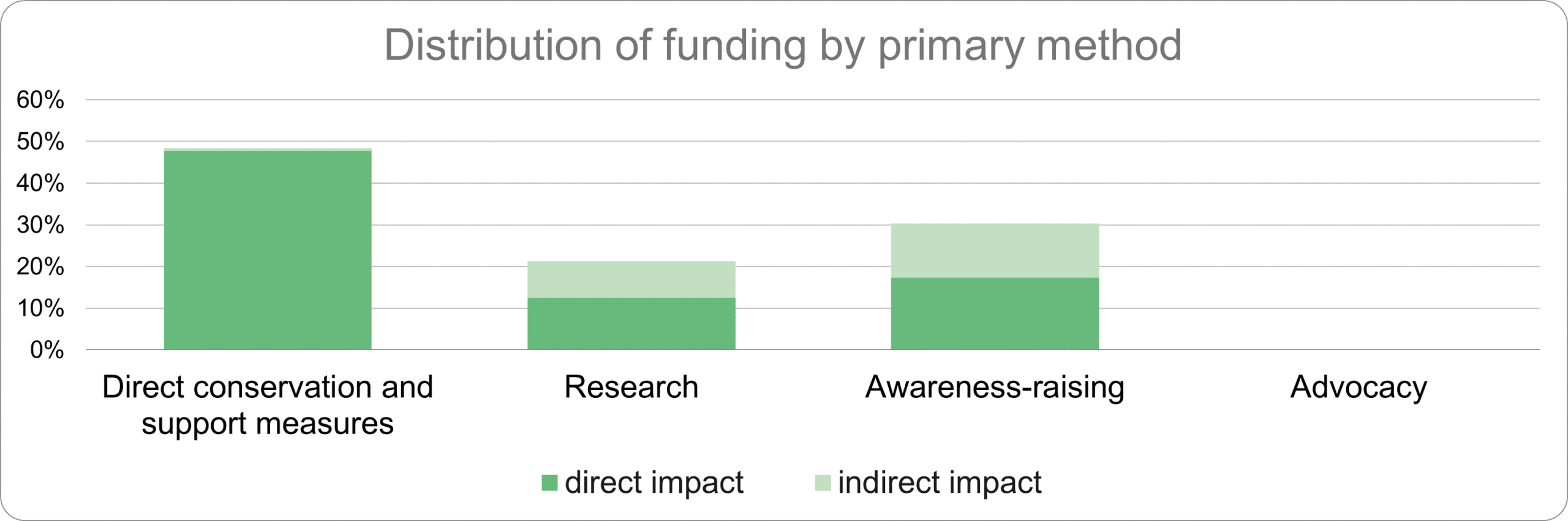
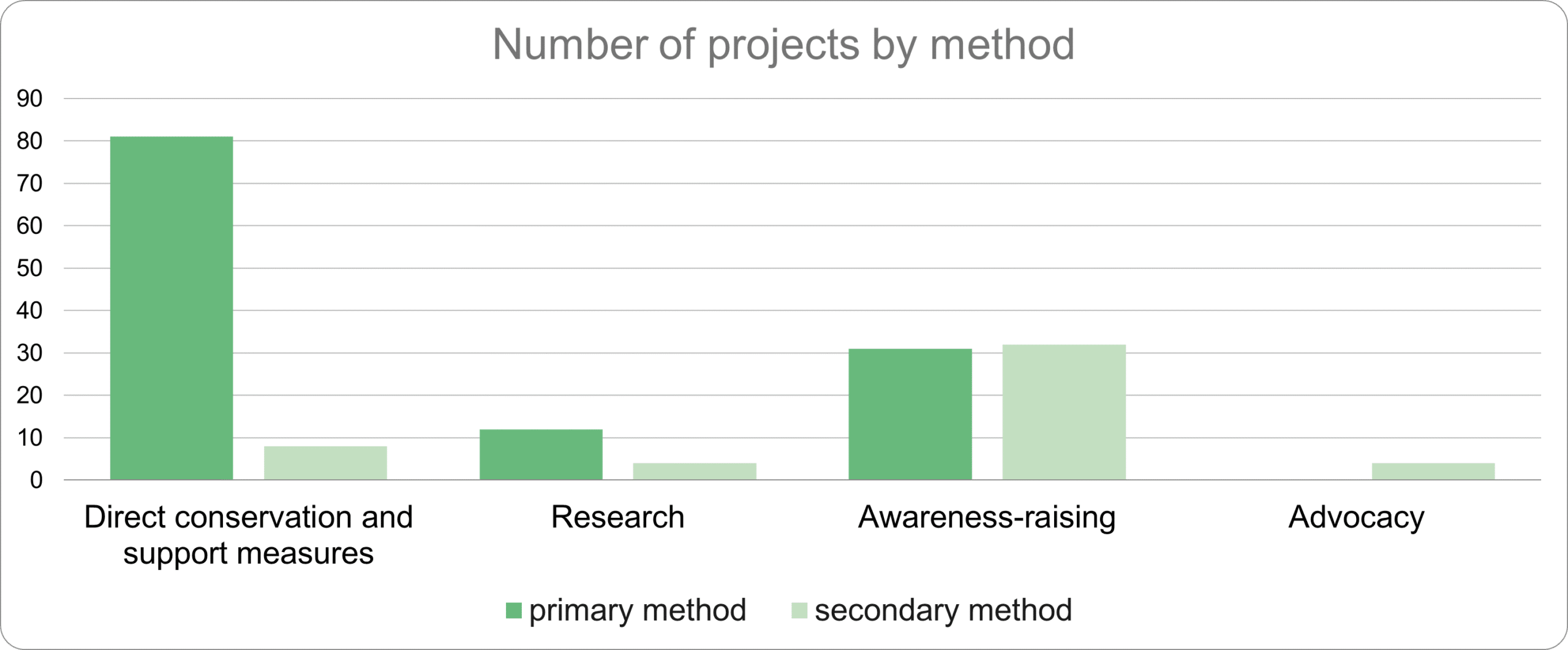
Direct conservation and support measures make by far the largest contribution to the preservation of biodiversity and account for nearly 48% of the total funding volume (CHF 2.9 million). Projects in the areas of research and awareness-raising contributed to biodiversity both indirectly and directly. It is also noteworthy that advocacy was not the primary method for any project this year. This is also reflected in the second graph, which shows that awareness-raising is often used as an additional method, while research and advocacy play a comparatively minor role.
Habitat
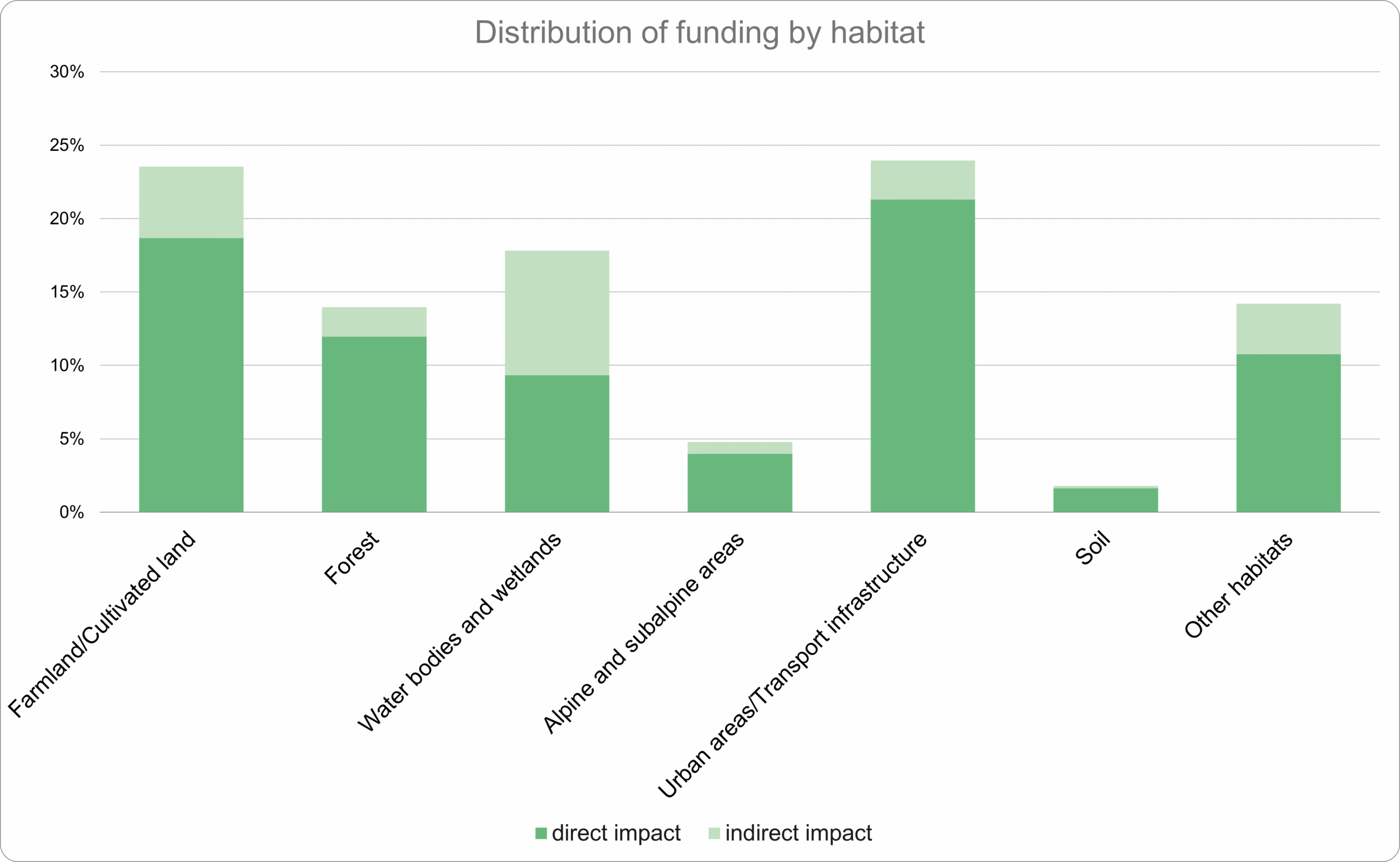
It is noteworthy that urban areas and transportation infrastructure, along with agricultural and cultivated land, received the most funding. This underscores the growing pressure on habitats in Switzerland and the need to specifically strengthen biodiversity in urban areas. Forests and water bodies ranked second, although projects in the area of water bodies primarily contribute to biodiversity indirectly (e.g., research). In contrast, alpine and subalpine regions, as well as soil, received significantly less attention.
Conclusions
The BioDivMeter is being published for the third time in 2025. While nine foundations with a total funding volume of 2.5 million participated in 2023, this year there are eleven foundations participating with close to 7 million in funding. The aim is to encourage additional foundations to participate in order to provide as comprehensive a picture as possible of biodiversity conservation efforts. The SCNAT report Understanding and Shaping Biodiversity in Switzerland (Vol. 21, No. 1, 2026) shows that pressure on biodiversity is greatest in agricultural areas, urban areas, and near water bodies. Accordingly, significant foundation funding is already flowing into these habitats. While wetland habitats are often still supported indirectly (e.g., through research), foundations are already backing numerous projects in agricultural and urban areas that have a direct impact on biodiversity.
Biodiversity in Swiss forests presents a mixed picture. In mountain forests, forestey interventions are generally decreasing, which promotes natural dynamics and thus biodiversity. Thus, foundations invest comparatively little in alpine and subalpine regions. At the same time, this habitat is heavily affected by climate change, which is why, according to the report, there is an increased need for action. Natural processes, more old-growth wood, stronger ecological support, and diverse forms of extensive land use are crucial for more resilient forests. The SCNAT report does not address soil separately, which makes a direct comparison difficult. Overall, foundations are already contributing to the promotion of biodiversity. However, this commitment should be continued and, if possible, expanded.
Call to Action
The BioDivMeter can only reflect part of the commitment to biodiversity in Switzerland (and abroad). The BioDivCommunity would be pleased if additional foundations chose to showcase their biodiversity engagement through the BioDivMeter. Foundations that are unable to share data but are interested in exchanging ideas on biodiversity conservation are welcome to join the BioDivCommunity.